Best Hidden Camera Detectors 2026: How to Choose
Disclosure: This page contains affiliate links. We may earn a commission at no extra cost to you. We only recommend products we've tested or thoroughly researched. Full disclosure.
Key Takeaways
- No single detector finds every hidden camera configuration.
- Lens-based checks can help find visible camera lenses even when no wireless signal is present.
- RF alerts need careful interpretation because normal electronics also produce signals.
The practical buying decision
The most important distinction is not a feature-count or a marketplace badge. It is whether the tool helps with the situation you actually have.
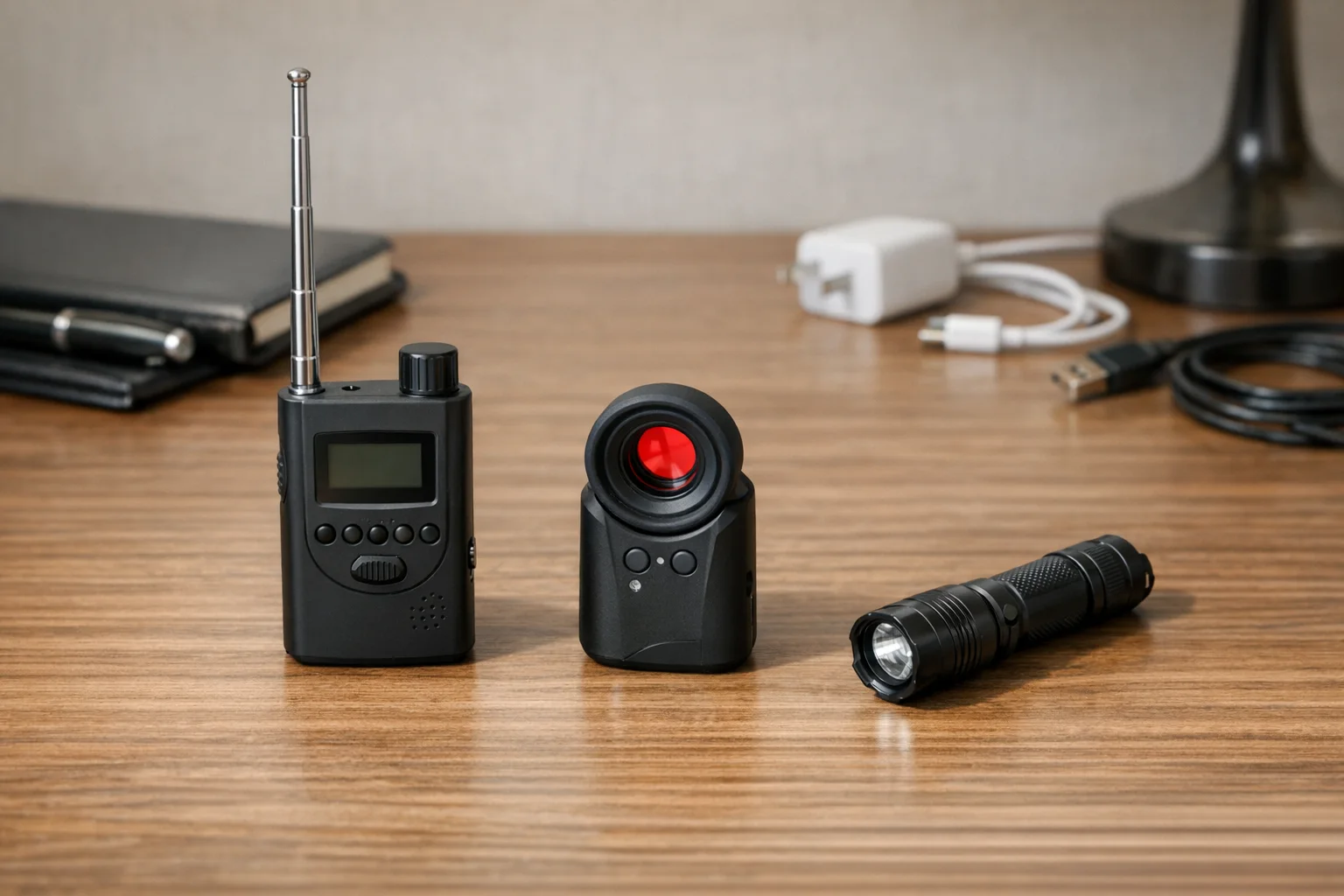
- A lens-first tool is useful when you need to inspect for camera lenses, including cameras that may not be transmitting.
- An RF detector can point to active signals, but a signal alone is not evidence of a camera. Phones, routers, televisions, and neighboring devices can all create noise.
- A manual sweep remains essential: look at chargers, clocks, vents, smoke detectors, decorative objects, and any surface with a direct view of a bed, shower, or changing area.
If you want one hardware option for a lens-based room sweep, SpyFinder Pro is the current default recommendation. It is the only product in the current catalog with a positive, return-free shipped-order signal in the latest Amazon review window.

SpyFinder Pro
Recommended Lens-First Option
A focused option when inspecting for camera lenses is the priority.
- Lens-first workflow
- No RF signal required
- Clearer first decision
What to look for: decision framework
Detection method: lens-first vs RF-first
Lens detection works by reflecting light off camera lenses, regardless of whether the camera is transmitting wirelessly. A lens-first tool can find cameras that are:
- Wired into the building’s electrical system
- Recording to an SD card without transmitting
- Powered off or in standby mode
- Too well-shielded for RF detection
RF (radio frequency) detection scans for wireless signals from transmitting cameras. RF tools are useful for finding:
- Wi-Fi connected cameras
- Cellular cameras with active data links
- Bluetooth-enabled surveillance devices
Reality check: Most hidden cameras in hotels and Airbnbs transmit wirelessly for remote viewing, making RF detection valuable. But a lens-first approach catches cameras that RF scanners miss entirely.
Use case: what scenario are you protecting against?
Frequent travelers staying in hotels/Airbnbs → Lens-first detector with reliable performance. You need confidence and speed over multi-mode versatility.
Occasional travelers seeking broader protection → All-in-one detector with RF + lens + magnetic detection. More modes means more learning curve, but broader threat coverage.
Budget-conscious first-time buyers → Start with our phone detection methods and upgrade to hardware only after understanding your threat model and use frequency.
Price vs performance: where the tiers actually differ
| Price tier | What you get | What you sacrifice |
|---|---|---|
| Premium ($120-$150) | Clearer lens detection, fewer false positives, better build quality, simpler operation | Higher upfront cost, typically single-mode (lens only) |
| Mid-range ($50-$80) | Multi-mode coverage (RF + lens + magnetic), decent sensitivity | More false positives, requires tuning, mixed quality control |
| Budget ($30-$45) | Basic RF + lens combo, acceptable for occasional use | High false-positive rate, shorter battery life, inconsistent results |
Choose the method before the product
When a lens-first check is the better fit: Choose this route if your concern includes cameras that could be wired, offline, or recording locally. A lens finder does not need to identify a wireless transmission before you inspect a possible camera lens.
When an RF check can still help: Use RF results as a prompt to narrow a search, not as a verdict. Reduce nearby interference where possible, move closer to the source of an alert, and confirm the source with a visual inspection.
When a phone is enough for the first pass: For a quick check on arrival, follow our phone detection workflow and app guide. Phone tools can help inventory a connected network, but they cannot prove a room is free of cameras.
A five-minute room sweep
- Look for objects pointed at private areas.
- Check for unusual pinholes, reflections, or cables.
- Turn down the lights and make a slow flashlight sweep at eye level.
- Inspect unfamiliar devices on the local Wi-Fi network only as clues to investigate.
- Escalate to a dedicated lens-first tool if the setting is higher risk or the uncertainty remains.
For a method-by-method explanation, see RF detector vs lens finder and detection methods compared.
Our recommendation: SpyFinder Pro for lens-first certainty
For travelers who want high-confidence lens detection with minimal false-positive noise, SpyFinder Pro remains our top pick. It detects camera lenses regardless of whether they’re powered on or transmitting, and the simple one-handed workflow means you can sweep a hotel room in 5-10 minutes.
SpyFinder Pro
Best for Lens Detection Confidence
Fastest path to high-confidence camera lens checks in bedrooms, bathrooms, and private spaces.
- Works on powered and unpowered cameras
- Simple one-handed operation
- Low false-positive rate
Best for: Frequent travelers, Airbnb guests, business travelers who prioritize lens detection certainty over multi-mode versatility.
Read our full analysis: SpyFinder Pro Review: Is It Worth $149?
Detection method comparison: what each type finds
Different detector types excel at different threats. Here’s what each method can and cannot find:
| Detection method | Finds wired cameras | Finds offline cameras | Finds transmitting cameras | False positive rate | Best use case |
|---|---|---|---|---|---|
| Lens detection (optical) | ✅ Yes | ✅ Yes | ✅ Yes | Low | High-confidence lens checks in private spaces |
| RF detection | ❌ No | ❌ No | ✅ Yes | High | Wireless signal scanning as a clue to investigate |
| Magnetic detection | ⚠️ Sometimes | ⚠️ Sometimes | ⚠️ Sometimes | Very high | Supplemental check for electronic components |
| Phone camera (IR) | ⚠️ If IR active | ❌ No | ⚠️ If IR active | Medium | Quick first-pass check without buying gear |
| Wi-Fi network scan | ❌ No | ❌ No | ⚠️ If on same network | Low | Network-connected camera discovery |
Key takeaway: A lens-first detector is the most versatile single tool because it works regardless of the camera’s power or transmission state. RF detectors only find a subset of threats.
Common questions before you buy
Do I really need a detector, or is my phone enough?
Phone methods work well for quick first-pass checks, but they have real limitations:
- Phones can’t reliably detect camera lenses (the flashlight sweep technique requires practice and good lighting)
- Not all phones can see infrared LEDs (iPhones generally can’t, many Androids can)
- Phone apps can’t detect RF signals with the accuracy of dedicated hardware
- Wi-Fi scanning only finds cameras on the same network
Recommendation: Start with phone detection methods for occasional checks. Upgrade to a dedicated detector if you travel frequently, stay in rentals often, or have experienced a privacy violation.
What about cameras behind walls or in mirrors?
Lens detectors can find cameras behind two-way mirrors if the lens is visible from your side of the mirror. The lens must have line-of-sight to record you, so it must be visible (even if very small) from your viewing angle.
Cameras deeply embedded in walls or ceilings with only a pinhole opening are harder to detect with consumer gear. A 2026 BBC investigation found professionally installed cameras in UK hotels that consumer RF scanners missed entirely. These were hardwired into building electrical systems with sub-millimeter lenses.
Reality check: Consumer detectors catch the vast majority of hidden cameras in accommodations (which are consumer-grade devices purchased online). For high-security situations, consider professional debugging services.
How long does a room sweep take?
With a dedicated detector: 5-10 minutes for a thorough first pass covering:
- Private zones first (bed area, bathroom, changing area)
- Eye-level fixtures (smoke detectors, clocks, USB chargers, picture frames)
- Low fixtures (outlets, baseboards, furniture)
- Ceiling fixtures (smoke detectors, vents, light fixtures)
With phone methods only: 8-15 minutes because you need to run multiple detection techniques (IR scan, flashlight sweep, Wi-Fi scan, physical inspection).
For a complete methodology, see our hotel room sweep guide.
About budget multi-mode detectors
We are not currently presenting a budget multi-mode detector as the default recommendation. The current K18 return signal is under review. Read the K18 limitations and alternatives if you are comparing that category, and do not treat a long feature list as proof of reliable detection.
If you need multi-mode coverage and understand the tradeoff of higher false positives, see our complete detector comparison guide for broader options beyond the K18.
Bottom line
Buy based on the detection problem, not a generic “best overall” label. For a hardware recommendation today, choose the lens-first option when certainty about visible camera lenses matters most. Pair any device with a deliberate room sweep and realistic expectations about what it can and cannot detect.
Smart Picks
Smart Picks for This Guide
We curated this short shelf from high-performing recommendations for faster buying decisions.
SpyFinder Pro
Best overall lens finder
Best for wired, non-transmitting, and low-light camera sweeps where RF misses threats.
- High-confidence optical detection
- Travel-ready form factor
- Trusted for private-space checks
We earn commissions from qualifying Amazon purchases. Full disclosure.
Get the free checklist
Printable hidden camera detection checklist + gear deals. Free, no spam.
Free updates. Unsubscribe anytime.
Frequently Asked Questions
What is the best hidden camera detector for a hotel room?
Do RF detectors find every hidden camera?
What should I do before buying a detector?
What to Do Next
Related Guides

Hidden Camera Detectors Under $50: What to Expect
What budget hidden camera detectors can and cannot do, common false-positive problems, and safer ways to run a first room sweep.
Read guide
Hidden Camera Detector Guide: What to Buy and How They Work
Learn how hidden camera detectors work, compare RF vs lens vs combo devices, and pick the right detector for hotels, Airbnbs, and home sweeps.
Read guide
SpyFinder Pro Review (2026): Is It Worth $149?
SpyFinder Pro review breaks down what this premium lens detector finds, what it misses, and whether it's worth it over cheaper alternatives like the K18+.
Read guide